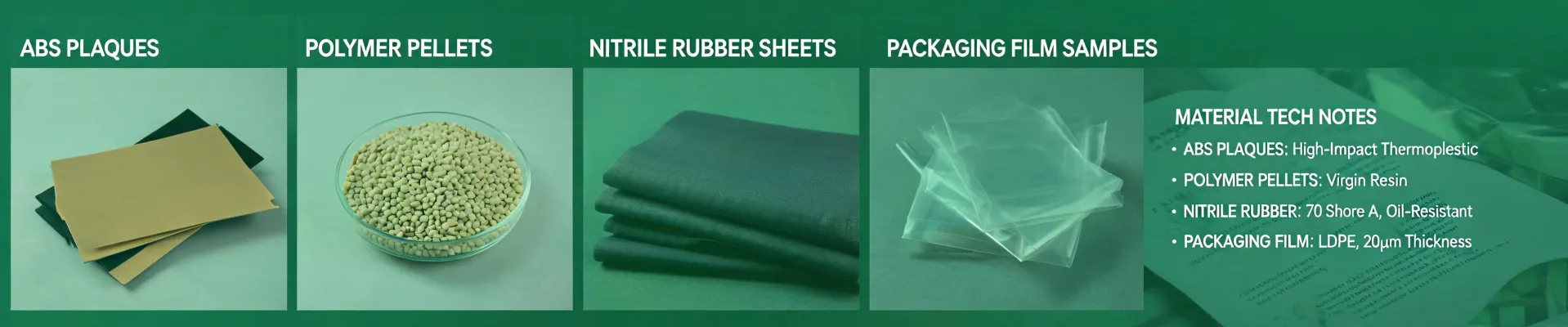
It started with a four-word email
Last spring, a maintenance planner forwarded me a one-line email: 'Is nitrile rubber heat resistant?'
They needed replacement rubber couplers for a transfer line that had started leaking. The old couplers failed after eight weeks, and someone wanted a quick material check before reordering.
I had a short answer in my head: 'Yes, nitrile can handle around 110°C.' Good thing I didn't send it.
I've been handling industrial material orders for seven years. I've personally made and documented 14 significant mistakes, totaling roughly $32,000 in wasted budget. That email almost became mistake number 15.
The surface problem is not the real problem
'Is nitrile rubber heat resistant?' looks like a property question. It isn't. It's an application question.
Nitrile rubber (NBR) can usually survive continuous temperatures around 100°C in air, maybe higher for short peaks. But that number depends on the formulation, the fluid around it, whether it's under mechanical stress, and what 'continuous' actually means in service. A rubber coupler in a dry, warm pump room is not the same as a rubber coupler near a steam vent. Same material, different lifespan.
People assume the data sheet tells you whether a part will work. What it actually tells you is how a specific test specimen behaved under specific test conditions.
The catalog answer is rarely the field answer
We learned this the hard way with a plastic bag holder.
A plastic bag holder that should have survived
A few years before the rubber coupler email, we supplied a simple plastic bag holder for a commercial kitchen. The holder kept sagging. The customer asked for a more heat resistant plastic.
We ordered an INEOS resin, a polypropylene homopolymer, because PP seemed like the obvious choice. Its melting point is around 160°C, and the kitchen air was nowhere near that. But the holder was under constant load at about 70°C, and over time the part crept. It didn't melt. It slowly bent.
People think the material caused the failure. The material was fine for the temperature. The problem was the missing requirement: load over time at temperature. We had checked the melting point and never asked about the actual service conditions.
The real cause: missing specs, not missing data
From the outside, it looks like material selection is about knowing material properties. The reality is that it's about defining the operating envelope. If you don't know the peak temperature, the contact fluids, the mechanical load, or the required service life, the material data sheet is just a brochure.
For the rubber coupler order, the same thing happened. We focused on nitrile's heat resistance and ignored that the application included steam contact. Nitrile rubber tends to harden after repeated steam exposure. The heat rating didn't matter because heat wasn't the only stress. Temperature and chemical exposure compound each other. You can't read them separately from the data sheet.
A material name is a shortcut, not a specification. I have to keep reminding myself of that. At the time, we thought we were being careful. We wrote 'NBR' on the PO, specified the shore hardness, and checked the price across three suppliers. What we didn't write down was how the part would be used. That seems like a small omission until a rubber coupler fails in a hot, steamy line and stops production.
What the wrong question costs
The rubber coupler mistake cost about $2,300 in rework and a two-week delay. I don't remember every line item, but I remember watching our supplier remake the same part for the same incomplete reason.
The plastic bag holder mistake was worse. A 1,200-piece order went to scrap. We had checked the resin property table, approved a drawing, and shipped parts that failed months later. The waste was several thousand dollars, and the credibility hit lasted longer.
The maintenance team kept asking for a 'better material'. What we actually needed was a better specification. The supplier was happy to sell us a different compound, but if we didn't define the failure mode, we were likely to repeat the same mistake with a more expensive material.
Why I now pay for certainty
In September 2024, we had an unplanned line shutdown and needed replacement rubber couplers quickly. One supplier quoted $1,420 with 'probably Friday' delivery. Another quoted $1,856 and guaranteed Thursday morning. The difference was $436. I chose the cheaper option.
The line was down Thursday. Lost production was around $1,100 per hour. The $436 'saving' turned into roughly $8,000 in downtime.
People think rush fees buy speed. They actually buy the absence of surprises. In an emergency, an uncertain cheap option is more expensive than a certain pricey one. That's the part I now budget for: time certainty. If the cost of missing the deadline is real, pay the premium. If not, save the money. But decide that before ordering, not after.
Granted, this only makes sense when the penalty for lateness is real. If a late delivery just means a slower week, the cheapest quote is fine. But when a deadline is tied to downtime, a client event, or a contractual penalty, certainty has a dollar value.
What I do now
Now when someone asks me 'Is nitrile rubber heat resistant?' I ask about the application first. I'm not being difficult. That's the process.
For any material request, we need at least the following:
- Peak and continuous temperature
- Fluids or media in contact with the part
- Mechanical load and how long it is applied
- Required service life
- Regulatory or food-contact requirements
For INEOS resin data, I log into the INEOS portal and pull the manufacturer's technical datasheet and processing guide directly. That doesn't mean the resin is right. It means I'm using the same data the manufacturer publishes, not a reseller's summary.
For rubber, I ask which standard supports the number. A common one is ASTM D2000, the classification system for rubber products, which covers heat aging and oil resistance requirements. If a rubber coupler doesn't have a classification behind it, the phrase 'heat resistant' doesn't mean much.
I also ask what happened before the failure. In most cases, there is a specific moment of failure. That moment is worth a thousand data sheets.
One more honest note: my experience is based on about 240 mid-volume industrial material orders, mostly mechanical components and simple plastic parts. If you're selecting materials for pressure vessels, medical devices, or aerospace applications, don't take a checklist from a blog post. Involve a materials engineer. My mistakes were expensive enough without adding that risk.
Start with the conditions, not the material name. If you don't know the conditions, the data sheet is just a brochure.
Ask About This Topic