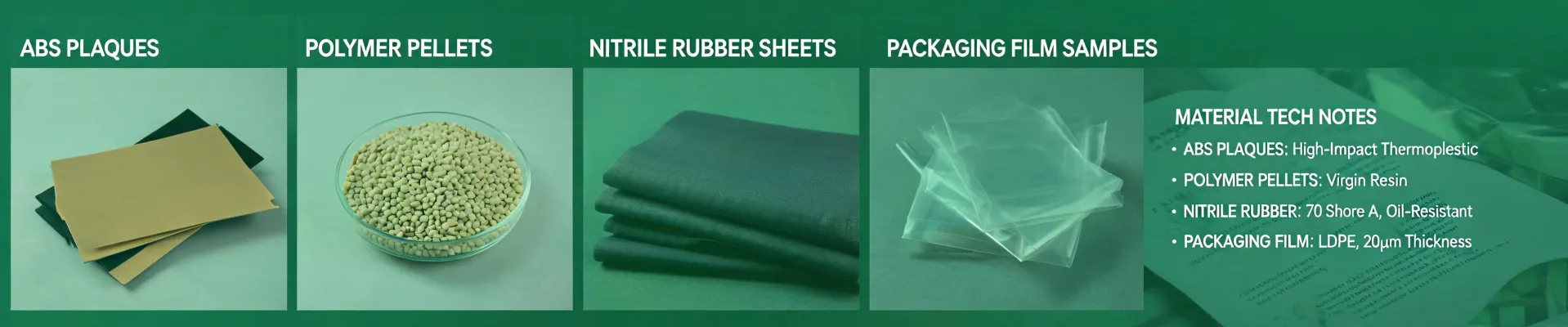
If you typed 'swimmer abs' into Google and landed here, I need to set the record straight: this post will not help you get a six-pack. We're talking about ABS the thermoplastic—acrylonitrile butadiene styrene—which, depending on the grade and the supplier, behaves a lot more like an investment than a workout.
I manage procurement for a mid-sized converting company. Over the past six years, I've tracked every order for raw materials—polymers, additives, and the occasional surprise charge—in our cost system. The question I get most from colleagues is: 'Which INEOS material should we specify?' My honest answer: it depends. There's no universal 'best' resin. There's only the right one for your product life, your market, and your buying power.
Three situations, three answers
Before you think about materials, figure out which situation you're in:
- Short-cycle products. Disposable packaging, bags, containers—products designed to be used for weeks or months, not decades.
- Long-life installations. Pipes, fittings, building materials—products expected to perform for a generation.
- Sustainable-spec projects. You need documented environmental claims, not just a green label on a sample chip.
Each situation leads to a different decision. Let's walk through them.
Short-cycle products: watch the polyethylene polymer details
If you're making packaging or disposable goods, the polyethylene polymer family is probably your starting point. HDPE, LDPE, LLDPE—all of them are polyethylenes, but they're not interchangeable. LLDPE gives you toughness for film. HDPE gives stiffness for bottles. LDPE is the flexible one that seals well. The lowest per-pound price is tempting, but the actual cost shows up in cycle time, scrap rate, and the number of 'off-spec' warnings in the QC log.
When I first started sourcing polyethylene, I assumed the cheapest resin per pound was always the best procurement target. That assumption lasted exactly three production runs. A 'cost-effective' LLDPE kept blowing out on our film line because the melt flow index was slightly outside what our extruder could handle. The redo cost us more than the savings. Now I calculate total cost of ownership: resin price, freight, processing speed, and scrap rate. The actual cost per good unit is what matters.
INEOS makes a broad range of PE grades, so you don't have to switch suppliers if your spec shifts. But use the supplier's technical team before you commit. Ask for processing latitude, not just a datasheet. A polymer that looks fine at 2 cents less per pound but runs 5% slower is not a bargain.
Long-life installations: how long do PVC pipes last?
If your product is going into the ground or into a building, the question changes from 'What's the cheapest price?' to 'How long does this need to last?' That's where PVC comes in. How long do PVC pipes last? In normal operating conditions—meaning proper installation, stable soil chemistry, and rated pressure—PVC pipe has a documented service life of roughly 50 to 100 years. I can't guarantee a century from any polymer, and neither should any supplier who wants your trust. What I can tell you is that PVC has decades of field data behind it.
The conventional wisdom in procurement is to get three quotes and take the lowest. That's the right approach for commodity products. For underground infrastructure, I'd say the opposite. A quote for pipe is not a quote for lifetime performance. Replacing a failed pipe is not the cost of pipe replacement—it's the excavation, the downtime, the disruption to other utilities. That's why total cost of ownership matters more than price per foot. I weighed this exact risk on a recent project: the cheapest PVC offered about $1,200 in upfront savings, but the potential failure cost was easily eight times that. Not worth it.
Ask your material supplier for the stress regression data for the specific PVC grade and the expected design life at your pressure rating. The ASTM standard you'll see cited is D1785 for pressure-rated pipe. But the real answer depends on your installation. That's why the supplier's technical support matters more than the discount they offer.
Sustainability and small customers: INEOS ABS USA and the proof problem
Now the situation I care about most: you're a smaller company, and you need either ABS or an environmental story. Maybe you're trying to switch from metal to a polymer enclosure, and a customer asked for a simple PCR (post-consumer recycled) content. Or you're buying your first 1,000 pounds of ABS and wondering whether a global producer will even take you seriously.
If you're in North America, the first name to know is INEOS ABS USA. That's the regional business for ABS resin and related styrenics. In my experience, the company's distribution network is where a small order lives or dies. The distributor sets the terms, the minimums, and the communication quality. So vet the distributor just as hard as you'd vet a direct supplier. Ask for technical support, ask for transfer records, ask for traceability. If a distributor treats your 200-pound trial order like a nuisance, do not expect them to treat your 2,000-pound order any better. When I was starting out, the vendors who treated my small orders seriously are the same ones I still use today—on much larger orders. Small doesn't mean unimportant. It means potential.
Now the word 'sustainability.' If you're searching for INEOS sustainability information, you'll find the company's 2024 Sustainability Report and its product stewardship efforts. That's useful context, but it's not evidence that a specific bag of resin is recyclable. Per the FTC's Green Guides (ftc.gov/green-guides), environmental claims like 'recyclable' must be substantiated. I have mixed feelings about recycled-content resins. On one hand, the product is greener. On the other, recycled feedstock can vary. So you absolutely need batch-to-batch consistency.
I used to think sustainability claims were a marketing department's job. What I mean is, I didn't ask for proof. Then a customer asked me to verify the recycled content in an ABS part, and I couldn't answer. That's when I switched to a supplier who could provide a certificate of analysis and a mass balance statement. (Should mention: the recycled ABS blend cost about 8% more. That's fine—if you explain the environmental attribute to your customer, most will pay for it.)
How to decide which situation you're in
Ask yourself three questions before you call a supplier.
- How long does the product need to function? If the answer is 'a few months,' stick with standard polyethylene grades. If it's 'decades,' move to PVC and demand engineering data.
- What will your customer measure? Upfront price, service life, or environmental footprint. That determines whether you should focus on cost per pound, design life, or certification paperwork.
- How much buying power do you have? If you're small, don't apologize for it. Use the supplier relationship as a test. The right distributor will ask about your growth, not just your current order size.
No single INEOS material is right for everyone. But once you know the product's lifespan, your customer's criteria, and the supplier's actual support level, the answer becomes surprisingly clear. And that is exactly the way a procurement decision should work.
Ask About This Topic