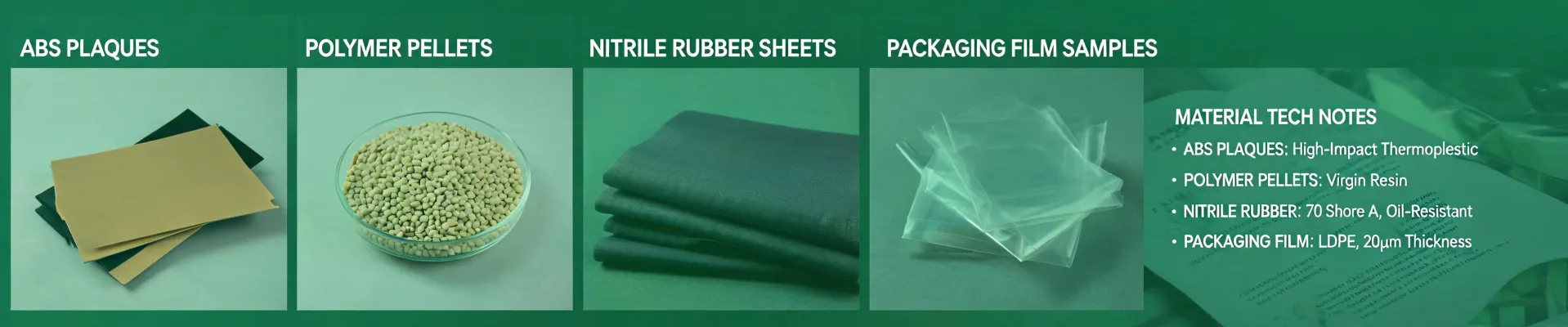
How are thermoplastic polymers made? It's a straightforward question with a deceptively complex answer: thermoplastic polymers are made by chemically linking monomers—single molecules like ethylene, styrene, and acrylonitrile—into long polymer chains through controlled polymerization under heat and pressure.
If you landed here searching for "drake's abs" instead—in this corner of the internet, ABS stands for acrylonitrile-butadiene-styrene, not a rapper's midsection. Either way, you're in the right place.
Here's why this knowledge matters: in eight years of coordinating material supply for plastics manufacturers, I've watched buyers make or break multimillion-dollar production runs based on how well they understood their materials. Understanding the basics makes you faster. And when the deadline is tight, that speed is money.
Why Understanding This Saves Time (and Money)
I'm a materials coordinator at a polymer distribution company. I've handled 200+ rush orders in my career, including same-day turnarounds for injection molders with production lines down and customers waiting.
The pattern is consistent: buyers who understand what they're buying make fast, confident decisions. Buyers who don't panic. And panic costs money.
Last quarter alone, we processed 47 rush orders. Or rather, 45 on time, 2 late. Both late shipments happened because the client specified a resin grade that wasn't in stock—an "equivalent" per the spec sheet that turned out not to be equivalent at all. If they'd known enough to ask about processing behavior, we'd have flagged the risk long before the loading dock.
The Short Version: How Thermoplastics Are Made
Full disclosure: I'm not a chemical engineer. If you need reaction kinetics or catalyst chemistry, I'll happily defer to someone with a lab coat. What I can give you is a supply-chain perspective that helps you ask better purchasing questions.
Step 1: From Feedstock to Monomer
It starts with crude oil or natural gas. Cracking these feedstocks yields olefins—ethylene, propylene, butadiene—plus aromatics like styrene. Producers like INEOS operate huge integrated sites where cracking, polymerization, and compounding happen on one campus. That integration isn't just for efficiency; it's a reliability advantage. Fewer transport steps mean fewer supply chain failures.
Step 2: Polymerization
Monomers link into long chains inside a reactor. There are two main reaction families:
Addition polymerization—monomers with double bonds join head-to-tail. This is how polyethylene, polypropylene, and polystyrene are made.
Condensation polymerization—monomers react and split off small molecules like water. Nylon and PET are made this way.
Step 3: Compounding
Raw resin gets mixed with additives: colorants, UV stabilizers, flame retardants, impact modifiers. This is where a polymer becomes a product. It's also where shortcuts get exposed—a compound that skimps on impact modifier will pass a written spec test, then fail abruptly on your cold-impact test.
Step 4: Pelletizing and Delivery
The compounded melt gets extruded into strands, cooled in a water bath, and chopped into uniform pellets. Those pellets are what your injection molder, extruder, or blow molder actually feeds on.
ABS: A Case Study in "Equivalent" Being a Trap
ABS brings together three monomers with distinct personalities. Acrylonitrile contributes stiffness and chemical resistance. Butadiene adds impact toughness—it's a rubber, literally. Styrene brings gloss and processability.
Why does this matter? Because two suppliers can sell you "ABS" with identical spec sheets, yet the materials behave completely differently in your mold. Monomer ratios, polymerization method (emulsion vs. mass), and rubber particle size distribution are hidden variables. Warpage, sink marks, weld lines—often material problems disguised as mold problems.
Here's a supply chain clue worth knowing: much of the acrylonitrile in ABS production comes from facilities like the INEOS Nitriles plant in Green Lake, Texas. If you're sourcing ABS and wonder why lead times are stretching, understanding that upstream sites like this feed the entire market gives you a genuine early-warning system.
The numbers once told me a cheaper alternative ABS would save 15% per kilogram. My gut said their sample didn't flow right on a customer's press—too sluggish, inconsistent shot weights. I stayed with the established material. Months later, I heard the cheaper source had processing inconsistencies that cost another buyer a $250,000 order. Sometimes the spreadsheet doesn't know everything.
Resin Molds and "Express" Service: A Reality Check
Even the right pellet won't save you if the mold is wrong.
Every thermoplastic shrinks differently as it cools. ABS runs about 0.4% to 0.7% shrinkage; polypropylene can shrink two to three times more. The mold has to be designed around the material's shrinkage, melt flow, and cooling behavior. Get the material grade wrong, and the mold produces rejects.
So-called "resin molds express" services exist for exactly this reason. I've paid $4,800 for a rapid aluminum mold in a pinch and considered it cheap versus the $50,000 production disruption it prevented. Not ideal, but workable.
In March 2024, a client called at 2 PM needing 500 kg of ABS and a mold for a production slot the next morning. Normal turnaround: five days. We found a tool shop with a compatible mold blank, paid $1,200 in rush machining on top of the $4,800 base, located the material in a warehouse two states away, and had it on a truck by 8 PM. The client's alternative was losing a $30,000 production window.
But I still kick myself—I hadn't asked, in that first call, what resin grade they were using. That one missing question cost two hours of verification and a delivery window that should've been 6 PM instead of 10. Garbage in, garbage out. Even an express mold won't fix bad inputs.
Thermoplastics vs. Thermosets: An Important Boundary
Take the INEOS Grenadier, the rugged 4x4 they build. If you're searching for an "INEOS Grenadier steering stabilizer" after a rough trail, you're dealing with polyurethane or high-grade rubber bushings. Those are thermosets, not thermoplastics.
Thermosets are cross-linked and cured in a mold; once set, they can't be re-melted. Thermoplastics can be reheated and reshaped. The trade-off: thermoplastics are recyclable and great for high-volume manufacturing; thermosets hold their shape under heat and constant load. For a steering stabilizer that continually absorbs vibrations and impacts, you want the thermoset. For a food container or a car bumper, you want the thermoplastic. Knowing which one you need before you order is considerably cheaper than discovering it after.
This is the boundary condition that catches many buyers off guard. "Plastic" isn't one family. It's several.
What 200+ Rush Orders Taught Me
Ask better questions. That's the whole game.
When a buyer calls and says "I need ABS," I ask: injection molding or extrusion grade? What melt flow index? What's the part's end use? What color, exactly? Sometimes they know. When they don't, we walk through a data sheet together. I'd rather spend ten minutes now than deal with mismatched material and an inevitable delay later.
There's something quietly satisfying about a coordinated rush order that lands exactly on time—the client's audible relief, the tool shop that came through, the truck that showed up when it said it would. It's not luck. It's preparation meeting an opportunity.
Honest Limits
This gets into chemical engineering territory fast, and that's not my expertise. If you need to design a new compound, run mold-flow simulations, or diagnose a recurring defect in an existing part, consult a polymer scientist or a tooling engineer. They'll get you further than any article can.
Also, not everything can be rushed. Polymerization takes time. Compounding lines have capacity limits. Steel doesn't cut faster because a deadline is real. Some lead times are pure process time; the rest is buffer that a good phone call can sometimes compress.
Honestly, I've never fully understood why some resin suppliers quote lead times they know they can't meet. My best guess: they'd rather win the order and manage the fallout later. Which is exactly why knowing how thermoplastics are made—even at a practical, sky-is-blue level—will make you a sharper buyer. You'll ask what's behind the price, the spec, and the delivery date. And you'll get better answers.
Ask About This Topic