-
Who this checklist is for
-
Step 1: Define the material by chemistry, not nickname
-
Step 2: Verify the supplier and material source
-
Step 3: Run a blind sample test
-
Step 4: Build a total cost model, not a unit price comparison
-
Step 5: Validate sustainability and compliance claims
-
Step 6: Lock specs into the PO and inspection plan
-
Step 7: Inspect incoming lots with a checklist, not a feeling
-
Step 1: Define the material by chemistry, not nickname
-
Common mistakes I still see
-
Bottom line
Who this checklist is for
If you're buying industrial rubber and plastic parts—ABS housings, HDPE plastic buckets, rubber bumpers, custom mats, nylon components—this checklist is for you. I'm a quality and brand compliance manager at a rubber and plastics company. I review every production batch before it reaches customers, roughly 220 items a year. In 2024, I rejected 18% of first deliveries due to spec drift, contamination, or missing documentation. This is the 7-step process I use to keep that from happening. It works whether you're evaluating an INEOS material, checking an INEOS ABS USA company data sheet, or sourcing INEOS Grenadier rubber floor mats from a converter. Your mileage may vary if you're buying low-volume prototypes versus full production.
Step 1: Define the material by chemistry, not nickname
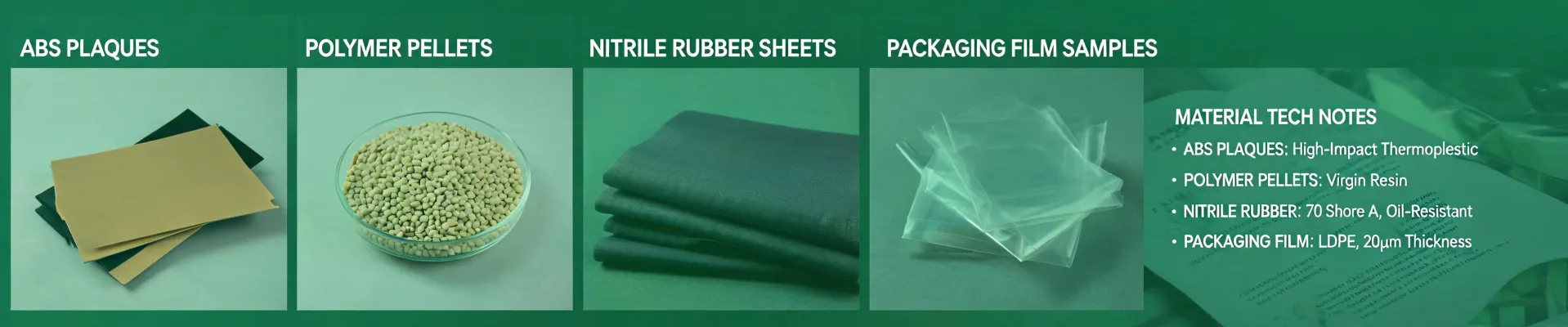
First, write the spec in polymer terms. “Plastic” isn't a spec. “Rubber” isn't a spec. If someone asks, “Is nylon a polymer?” yes—nylon is a polyamide polymer. That matters because polymer family drives moisture absorption, chemical resistance, and wear. For ABS, specify grade, impact strength, UV package, and color. For an HDPE plastic bucket, define wall thickness, stress crack resistance, and food-contact status if needed. For a rubber bumper, specify EPDM vs nitrile vs SBR, hardness (Shore A), and compression set. For INEOS Grenadier rubber floor mats, define the backing, edge trim, and odor limits. If you don't define it, the vendor will define it for you—usually by what's in stock.
Step 2: Verify the supplier and material source
Check who actually makes the polymer. If a quote says “INEOS ABS,” ask for the resin lot, manufacturer name, and country of origin. If you're dealing with the INEOS ABS USA company, confirm the legal entity on the invoice matches the documentation. I've seen traders pass off generic resin as branded material. One batch of 8,000 ABS parts failed drop testing because the “equivalent” resin had lower impact strength. The vendor claimed it was “within industry standard.” We rejected it. They redid it at their cost. Now every contract includes resin source and lot traceability.
Step 3: Run a blind sample test
Don't just look at the sample. Put it in the application. For a rubber bumper, mount it, cycle it, and check compression set after 72 hours. For an HDPE plastic bucket, fill it, drop it, and leave it under UV. For INEOS Grenadier rubber floor mats, test fit, pedal clearance, odor, and cleaning. I ran a blind test with our maintenance team: same rubber bumper, two suppliers, different backing. 70% identified one as “more professional” without knowing the brand. The cost increase was $0.38 per piece. On 12,000 units, that's $4,560—worth it for fewer field complaints. But if your volumes are 500 units, that math changes. This worked for us, but our situation was moderate-volume industrial production. Your mileage may vary if you're a one-off prototype shop.
Step 4: Build a total cost model, not a unit price comparison
This is where value over price matters. The lowest quote often isn't the cheapest. I knew I should get written confirmation on a delivery date, but thought “we've worked together for years.” The verbal agreement got forgotten. The line stopped for two days. That delay cost us $6,200 in overtime and lost output. The part itself saved $200. Bottom line: price is what you pay; cost is what happens after it arrives. Add inspection time, scrap, rework, warranty, freight, and downtime. For a raw material like INEOS polypropylene or ABS, a 3% price difference can disappear if the lot needs sorting. For a finished part like an HDPE plastic bucket, a thin wall that cracks in the field is a brand problem, not just a returns problem.
Step 5: Validate sustainability and compliance claims
If a supplier says “recyclable,” “eco-friendly,” or “green,” ask for the basis. According to the FTC Green Guides (ftc.gov/green-guides), environmental claims like “recyclable” must be substantiated and should reflect actual consumer access to recycling. A plastic bucket isn't automatically recyclable everywhere. A rubber bumper may not be recyclable at all in your region. INEOS publishes sustainability reports, but that doesn't mean every compound you buy carries the same story. You still need the data sheet, the test report, and the end-of-life path. Don't let “sustainable” become a vibe. Make it a line item.
Step 6: Lock specs into the PO and inspection plan
Your purchase order should repeat the critical-to-quality dimensions. Don't rely on “same as last time.” I skipped the final review once because we were rushing and “it's basically the same as last time.” It wasn't. The color masterbatch was off, and we ended up with 1,200 units that didn't match the assembly. That was a $4,800 mistake including sorting and repress. Now every PO includes a signed spec sheet, a first-article inspection requirement, and a sampling plan. For rubber, that means hardness, tensile, elongation, and compression set. For plastics, that means melt flow, density, color, and dimensions. If the supplier can't sign it, they're not ready for production.
Step 7: Inspect incoming lots with a checklist, not a feeling
Write a one-page incoming inspection form. Include: resin lot traceability, visual defects, dimensions, color match, odor, hardness, and packaging. For an HDPE plastic bucket, check lid fit, handle pull, and drop test from 1.2 meters. For a rubber bumper, check mounting holes, surface finish, and durometer. For INEOS Grenadier rubber floor mats, check fitment, edge peel, and chemical resistance. Keep photos of approved and rejected samples. When a lot fails, you need evidence, not opinion. This is the step most people skip because it feels like extra work. It's not. It's the cheapest insurance you'll buy all year.
Common mistakes I still see
- Assuming “industry standard” means your standard. It doesn't. Your application has specific loads, chemicals, and UV exposure.
- Skipping written confirmation. A handshake is fine until it isn't. Get specs, dates, and change approvals in writing.
- Letting price decide the supplier. The $80 saved on expedited shipping can turn into $400 in rush reorders. The cheap part can turn into a field failure.
- Confusing material brand with material performance. Just because a compound is from INEOS or another reputable producer doesn't mean the finished part is right. Process, tooling, and quality control matter.
- Ignoring context. A checklist that works for 50,000 units may be overkill for 50. Adjust the sampling and documentation to your risk. I can only speak to industrial B2B production. If you're dealing with aerospace or medical, the calculus is different.
Bottom line
You don't need a perfect supplier. You need a repeatable process. Define the polymer, verify the source, test the sample, model the total cost, validate claims, lock the spec, and inspect the lot. That's how you avoid the expensive surprises. And if you're comparing INEOS ABS, HDPE plastic buckets, rubber bumpers, or nylon components, remember: the cheapest quote is just the start of the story, not the end of it.
Ask About This Topic