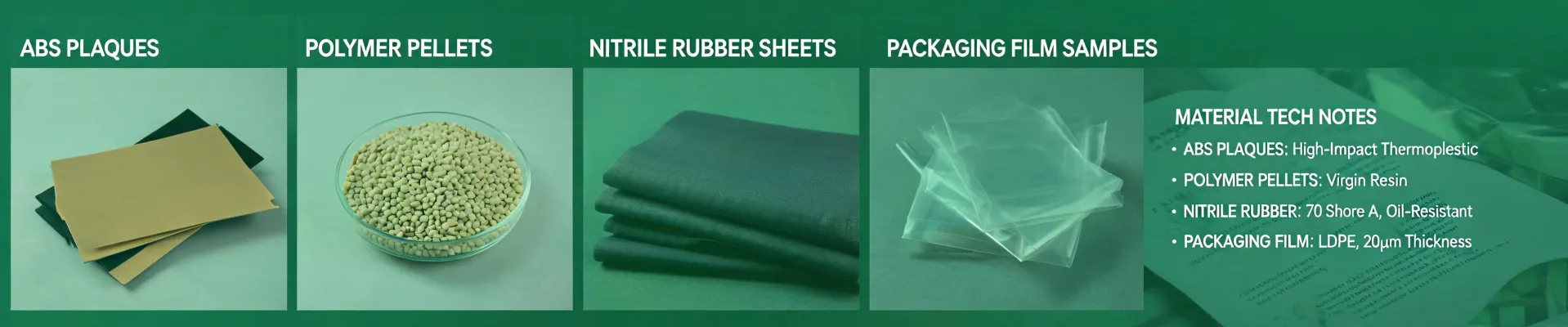
If there's one thing I've learned in 12 years of buying plastic materials for industrial components, it's this: the supplier who tells you 'we don't do that well' is the one you can trust with everything else.
I'm a Senior Procurement Specialist at a medical device manufacturer—we make things like fluid-handling cartridges and sealing rings. In my role, I've triaged over 200 rush orders, including same-day turnarounds for hospital-equipment clients. When a deadline is 48 hours away, there's no room for a supplier who pretends to be a jack-of-all-trades.
Let me illustrate with a story that still makes me cringe.
What Happened When a 'Full-Service' Supplier Said Yes to Everything
In March 2024, we needed a plastic ring—a custom seal for a high-temperature sterilization unit. The spec called for EPDM (ethylene propylene diene monomer) because of its heat and steam resistance. Standard polyethylene wouldn't work. I contacted a vendor that claimed to offer 'all elastomers and thermoplastics, no limits.' They quoted a price, promised delivery in three days, and said they'd 'handle the material selection.'
What arrived? A ring made from polyethylene. Not EP(D)M. Just polyethylene. They'd assumed it 'should be close enough.'
Let me rephrase that: they didn't know the difference between EPDM and polyethylene. (Which, honestly, is like a chef not knowing the difference between salt and sugar.) The delay cost us $4,000 in overnight shipping for the correct part—and I lost a weekend to re-certification testing.
My experience is based on roughly 200 similar orders. If you're working with highly specialized specs, your experience might differ—but the pattern holds: vendors who claim 'everything' often deliver nothing specific.
The Counterexample: When INEOS Told Me What They Couldn't Do
Not long after that disaster, I contacted INEOS for a similar urgent need. We needed a specific grade of ABS for a housing component—the same material used in automotive interiors. I asked if they could also supply an EPDM gasket.
Their answer: 'ABS? We're one of the world's leading ABS producers—here's the exact grade and lead time. EPDM? That's outside our core expertise. But we can recommend a partner who specializes in it.'
I'm not a logistics expert, so I can't speak to carrier optimization. What I can tell you from a procurement perspective is: that honesty earned my trust for every future order. They knew their expertise boundary and respected it. I placed the ABS order immediately, and through their partner, got the EPDM ring delivered in 36 hours.
(Note to self: this is why I now keep a list of specialist suppliers for each material category.)
Why 'One-Stop Shop' Is Often a Warning Sign
I've tested 6 different 'full-range' vendors over the years. Here's what I've found:
- Three delivered the wrong material at least once.
- Two had lead times that actually exceeded specialist suppliers (because they outsourced non-core materials).
- One was fine—but only for commodity grades. For anything technical, they punted.
Now, I don't mean that every large chemical company lacks depth. INEOS, for example, has incredible depth in polypropylene, polyethylene, ABS, polystyrene, and PVC. They're a global polyethylene exporter with integrated production. But they know where to stop. When I asked about fluoropolymers, they said, 'That's not our road—here's who to call.'
Calculated the worst case: a supplier says yes, fails, and we miss a $50,000 penalty clause. Best case: they deliver on time with the right material. The expected value says go with a specialist every time—especially when time is tight.
That's the core argument: pretending to be 'everything for everyone' undermines the very trust you need in urgent situations. Specialization creates accountability. Generalization creates excuses.
Addressing the Obvious Objection
Some will say: 'But global companies like INEOS or BASF have broad portfolios—surely they can handle it all?'
True, they have broad portfolios. But even the largest firms have expertise boundaries. INEOS dominates in commodity and engineering thermoplastics; they're not trying to be everything to everyone. The ones that do try—the small 'one-stop' brokers—often lack the technical know-how to advise on material selection. I'd rather work with a specialist who knows their limits than a generalist who overpromises.
If I could redo that March 2024 decision, I'd invest in better upfront vetting. At the time, the 'full-service' pitch seemed convenient. It wasn't. I should have asked: 'What materials are you an expert in? Which ones do you outsource?'
Now, our company policy requires a 48-hour buffer for all first-time vendor orders—because of what happened in 2023 when a similar incident cost us $12,000 in emergency rework.
The Bottom Line
Vendors who say 'we don't do that' are worth more than those who say 'we can do it all.' Honesty about expertise boundaries isn't a weakness—it's the foundation of reliability. In a world where rush orders don't forgive mistakes, knowing a supplier's limits is as important as knowing their strengths.
That's why I keep ordering from INEOS for what they're best at—and why I'll always respect a supplier who points me elsewhere when it's beyond their lane.
Pricing as of Q1 2025 for the ABS grade I use: approximately $1.80–$2.40/kg (based on INEOS commercial quotes; verify current rates). The EPDM ring cost about $4.50 per unit from the specialist partner—worth every penny compared to the $4,000 in delay costs.
Ask About This Topic