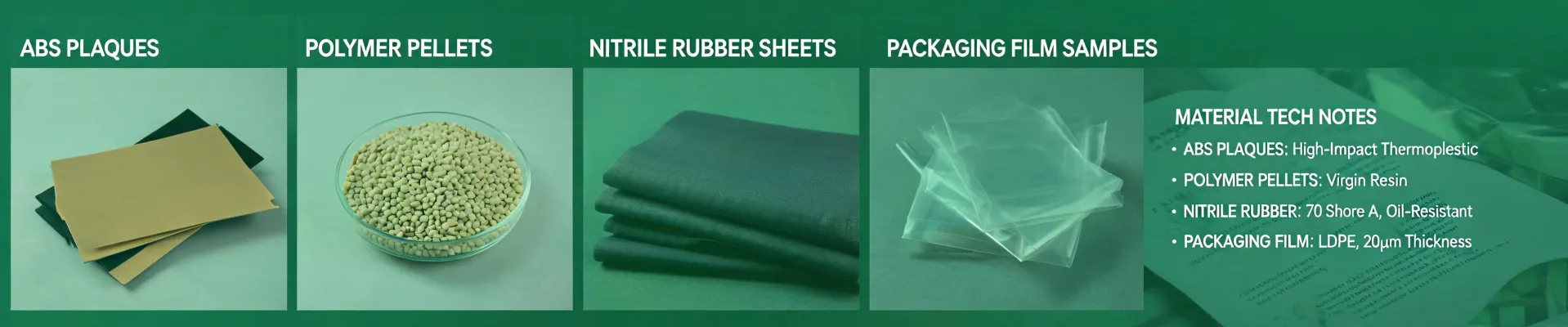
If you've ever had a batch of injection-molded parts arrive looking pristine, only to have them crack, fade, or warp after a few months in the field, you know the feeling. It's not just expensive—it's embarrassing. You specified ABS, a workhorse plastic. How could it fail?
I've been handling technical polymer orders for seven years now, and I've personally made (and documented) a few significant mistakes. The one that still stings happened in September 2022. I approved a $3,200 order for ABS housings for a client's outdoor sensor array. The parts looked perfect. Six weeks later, they were brittle and chalky. The client was furious, and I had a lot of explaining to do.
The Surface Problem: “This ABS is Total Garbage”
That was the client's first reaction. And it's the reaction most buyers have. When a plastic part fails, the immediate assumption is the material is bad—cheap, poorly made, or counterfeit. They focus on the obvious factor: the brand name of the resin. They blame "ABS" as a category.
But here's the thing: ABS is not a single material. It's a family of materials. The ABS used for a Lego brick is very different from the ABS used for a car dashboard. And neither is remotely suitable for, say, a UV-exposed outdoor sensor housing.
Most buyers focus on the polymer type and completely miss the additive package—the specific blend of stabilizers, UV inhibitors, and impact modifiers that determine how that plastic will perform in the real world.
The question everyone asks is: "Is this ABS?" The question they should ask is: "Which ABS? And formulated for what?"
The Deeper Cause: The Secret Life of an ABS Pellet
To understand why that $3,200 order failed, you have to look at what an ABS pellet contains. A generic ABS resin from a commodity supplier might contain:
- Acrylonitrile (gives chemical resistance and heat stability)
- Butadiene (provides impact resistance and toughness)
- Styrene (contributes rigidity and gloss)
- A very basic antioxidant package meant for indoor, short-term use
That's it. It's designed for toys, appliance housings, and indoor consumer goods. It's not designed for UV exposure. It's not designed for thermal cycling. It's not designed for years of service life outdoors.
Now contrast that with a premium, UV-stabilized ABS grade from a supplier like INEOS. The pellet recipe includes:
- The same three monomers, plus
- Stronger antioxidants (phenolic and phosphite types)
- UV absorbers (benzotriazoles or HALS – hindered amine light stabilizers)
- Impact modifiers tailored for low-temperature toughness
- Lubricants for better mold release (which reduces internal stress)
That's the difference. It's not cosmetic. It's the difference between a part that lasts three months and a part that lasts three years. And unless you're asking the right questions, you'll never know which one you're getting.
The Cost of Getting It Wrong
That failed sensor housing order taught me a lesson I won't forget. Let me lay out the real math.
First, there's the obvious cost: the $3,200 in materials we had to scrap. But that's just the tip of the iceberg.
There was the redo cost: expedited tooling adjustments (which, honestly, felt excessive at $850), a rush order for the correct UV-stabilized ABS (at a 35% premium), and overnight shipping. Total: ~$2,100.
Then there were the hidden costs: the client's lost time, the damage to our reputation (they went with a competitor for the next project), and the three weeks of internal meetings to figure out what went wrong.
The real cost of that mistake wasn't $3,200. It was closer to $6,000 in direct losses, plus an incalculable amount of trust.
Since then, I've maintained a pre-order checklist for our team. It's caught 47 potential errors in the past 18 months (surprise, surprise—material spec errors are the most common). That one lesson has saved us multiples of the original loss.
The Solution: What We Do Now
Honestly, the solution isn't complicated once you know the landscape. It's not about buying the most expensive resin or over-engineering everything. It's about asking the right questions upfront.
Now, for any project, our material checklist covers three things:
1. The Environment. Not just "outdoor" or "indoor." Specifically: UV exposure (direct sun? how many hours?), temperature range, chemical exposure (cleaning agents, oils, solvents), mechanical load (static or dynamic?), and expected service life.
2. The Resin Data Sheet. I don't just check the polymer type. I look for specific properties: Izod impact strength (notched), flexural modulus, heat deflection temperature (HDT), and—critically—the additive package description. If it says "general purpose" or "standard," I know I need to dig deeper.
3. The Supplier's Track Record. I now prefer to work with suppliers who can provide technical data sheets (TDS) and material certifications for specific grades. A supplier like INEOS, for example, doesn't just sell "ABS"—they sell specific formulations (e.g., INEOS ABS 5000 series for high impact, or UV-stable grades for outdoor use). That documentation is my safety net.
If your supplier can't or won't provide a detailed TDS, that's a red flag. Real talk: that's usually a sign you're getting a commodity, off-spec, or recycled material with unknown provenance.
Look, I'm not saying budget materials are always wrong. For a disposable indoor part, a generic ABS is fine. But for anything that's going to see real-world conditions—UV, heat, cold, chemicals—the spec sheet is your best friend. And the difference between "cheap ABS" and "spec'd ABS" is the difference between a happy customer and a $6,000 lesson.
Take it from someone who learned the hard way.
Ask About This Topic