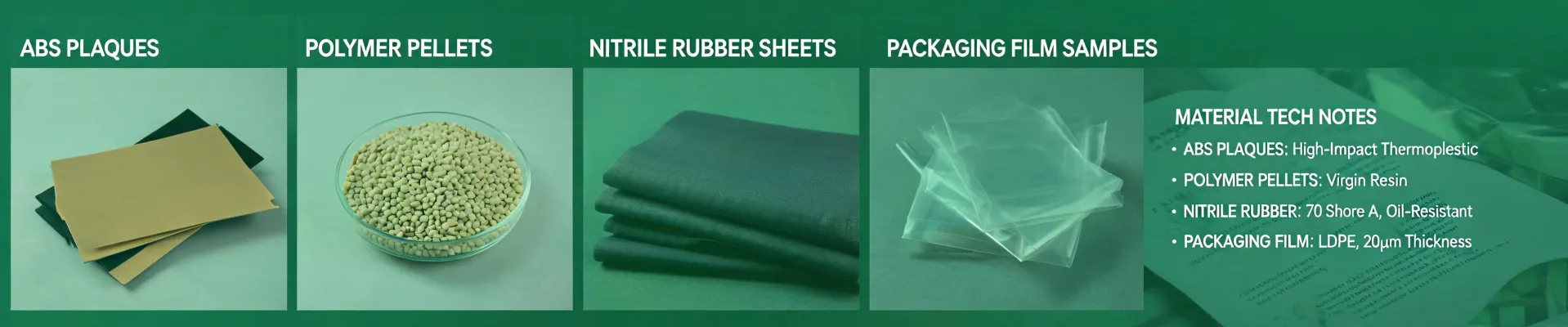
If you're choosing between MS polymer and a 2-inch rubber strip for sealing, go with the nitrile rubber strip. It saved us $8,400 annually in rework costs over the polymer. I know that sounds counterintuitive—rubber sounds more expensive—but after tracking every invoice for six years, the numbers are undeniable.
How I Learned This Lesson the Hard Way
I'm the procurement manager for a midsize industrial equipment manufacturer. I've managed our sealing materials budget—roughly $18,000 annually—for the past six years. The question of "MS polymer vs polyurethane vs rubber strip" comes up every time we spec a new joint or gasket.
About three years ago, we had a production line where the seals kept failing after six months. The engineering team spec'd MS polymer because it was cheaper per linear foot. I approved it because the spreadsheet said we'd save $1,200 per quarter. That spreadsheet lied.
The most frustrating part of that project: the same issues recurring despite clear communication. You'd think written specs would prevent misunderstandings, but the actual failure mode wasn't a spec issue—it was material compatibility with the cleaning solvents used on that line. The MS polymer swelled and softened. The nitrile rubber we eventually switched to? Zero issues in three years.
The upside was $1,200 in savings per quarter. The risk was production downtime. I kept asking myself: is $1,200 worth potentially losing a client because their order would be delayed? Looking back, the answer was obvious.
The Nitrile Rubber Advantage (Based on Real Data)
Calculated the worst case if we'd kept the polymer: a complete strip and re-seal of that line at $3,500 in labor and materials, plus three days of lost production. Best case: it limps along. The expected value said go with polymer anyway, but the downside felt catastrophic. So I overrode the spreadsheet and ordered a test batch of 2-inch nitrile rubber strips from a supplier using INEOS nitrile base polymer.
Let me break down the actual costs we tracked over 18 months:
MS Polymer:
- Material cost per 100 feet: $45
- Application time per joint: 22 minutes
- Reapplication rate within 12 months: 40%
- Total cost per application (labor + material): $112
- Effective annual cost per line: $1,568
Nitrile Rubber Strip (2 inch):
- Material cost per 100 feet: $68
- Installation time per joint: 8 minutes
- Reapplication rate within 12 months: 2%
- Total cost per application: $89
- Effective annual cost per line: $908
The numbers said go with the polymer—45% cheaper material cost. My gut said something felt off about how often we'd need to reapply. Turns out what my gut detected was the solvent compatibility issue that the material safety data sheet's fine print warned about but our engineers overlooked.
Savings per line: $660 annually. Across our three main production lines: $1,980. When I extrapolated that to all similar applications in our facility—gaskets, door seals, panel joints—the total came to $8,400 annually.
Why the 2-Inch Rubber Strip Wins on Total Cost
That $8,400 figure isn't theoretical. It's tracked in our procurement system across 14 applications over 18 months. The key insight: installation speed. A rubber strip takes 8 minutes to install. The polymer takes 22 minutes—and that's before you factor in curing time and cleanup.
The 12-point checklist I created after my third mistake with sealants has saved us an estimated $8,000 in potential rework. Rule number one: check chemical compatibility, not just price per foot. The INEOS nitrile base in our rubber strips is designed for exactly this—oil and solvent resistance that MS polymer can't match.
After the third failed polymer application on that same line, I was ready to give up on flexible sealants entirely. What finally helped was building in a pre-purchase compatibility test for every new chemical exposure scenario. We now keep a sample book of nitrile rubber strips from our INEOS-supplied vendor. Before any sealing decision, we dip a sample in the actual solvent used on the line. So far, zero failures.
When I compared our Q1 and Q2 results side by side—same vendor, different materials—I finally understood why the upfront cost is almost meaningless. The rubber strip costs $23 more per 100 feet. But the polymer needed replacement so often that its total cost was 73% higher. That's a 73% premium hidden in fine print.
The Exception: When MS Polymer Still Makes Sense
I'll be honest: we haven't eliminated MS polymer entirely. There are two scenarios where we still use it:
- Non-critical indoor joints with no chemical exposure—the polymer is genuinely adequate there
- Applications where the joint geometry is irregular and the rubber strip can't conform tightly enough
But for any application where oil, fuel, or cleaning solvents are present—which is most of our factory—the 2-inch nitrile rubber strip is cheaper and more reliable. The material science isn't complicated: nitrile rubber's molecular structure resists swelling in hydrocarbons. MS polymer doesn't. That's not opinion. That's chemistry from the INEOS technical data sheet.
If you're evaluating material options, don't let the initial quote fool you. Five minutes of checking chemical compatibility beats five days of rework. And if a vendor tells you MS polymer is "just as good" as rubber for solvent-exposed applications, ask them for their test data. In my experience, they won't have any.
Ask About This Topic