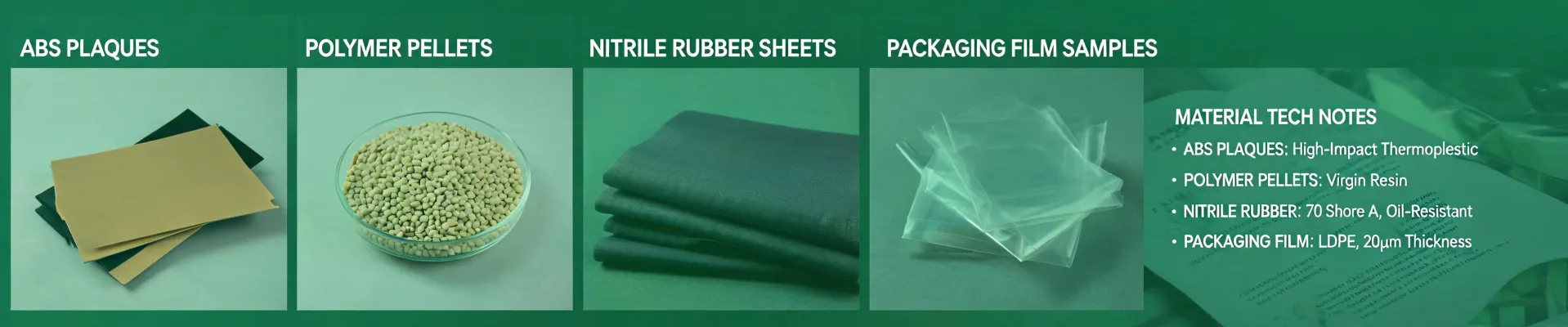
Get the ABS plate specs right, or expect delays and rework. I learned this the hard way so you don't have to.
If you're ordering ABS plates for a production run and you haven't triple-checked your thickness tolerance, your vendor's lamination process, and the exact grade of material from a supplier like INEOS, you're probably going to lose money. I say that from direct experience: on a 500-piece order in early 2023, a 0.2mm tolerance error cost us $2,800 and a two-week production delay. The core issue wasn't the supplier's fault—it was my assumption that 'ABS plate' meant one standardized thing. It doesn't.
Let me save you the trouble of that particular mistake.
What went wrong and what it cost
In February 2023, I specified ABS plate for an enclosure project. Simple enough, right? We'd used it before. But this time, the application required a specific flexural modulus for structural support that I didn't properly communicate. The material shipped was a general-purpose extrusion grade, not the high-impact sheet we actually needed.
The result: 500 pieces, all at the wrong stiffness, straight to scrap. $2,800 cost for the material plus $1,200 in rush reorder fees, and a 10-day production delay.
I still kick myself for not specifying the exact INEOS grade, like an ABS with a defined melt flow rate or impact resistance. What I mean is: I should have written 'INEOS ABS, Grade [X], min. Izod impact 200 J/m, thickness 3.0 mm ±0.1 mm' rather than just 'ABS plate, 3mm.' The difference in cost was negligible, but the cost of my omission was enormous.
Key specifications you must nail down
In my experience, these are the top three things procurement and engineers get wrong on ABS sheet orders:
- Thickness Tolerance. Standard extruded ABS sheet has a tolerance of about ± 10%. So, a 3mm nominal sheet can be 2.7mm or 3.3mm. For many applications, this is fine. For press-fit or tight tolerance assemblies, it's a disaster. If you need 3.0mm ±0.05mm, you need to specify this upfront. A good supplier can provide it, but you have to ask. (Should mention: we didn't, and our clips wouldn't hold.)
- Material Grade & Impact Resistance. Not all ABS is the same. Standard ABS has a notched Izod impact of around 200-400 J/m. If your part will see any shock loading, you need a high-impact grade. The rule of thumb is: if you can break it with a hammer, you need the tougher grade. Check the supplier's technical data sheet (TDS) and match it to your application, not just the material name.
- Sheet Size & Flatness. ABS sheet can have internal stresses from the extrusion process. If you're doing CNC routing or laser cutting, these stress points can cause warping during or after machining. Specify a stress-relieved or annealed sheet if you are doing any post-processing. A 4' x 8' sheet that lies completely flat is harder to find than you think.
How to avoid the common pitfalls
I've had mixed feelings about involving technical sales reps from companies like INEOS in the past. Part of me thought, 'I know what ABS is.' Another part realized, after the $2,800 mistake, that I absolutely didn't know the specifics for that job. Now, I run a simple checklist for every material order:
- Step 1: Get the TDS. Never order a material without its full technical data sheet. Review it for the specific properties relevant to your application—not just the generic ones.
- Step 2: Get a physical sample. A spec sheet can lie (rarely, but it can). A physical sample of 100mm x 100mm will tell you about surface finish, color consistency, and stiffness in a way a PDF cannot. The approval of the sample is your true first gate.
- Step 3: Define the acceptance criteria in writing. Include thickness, flatness, color (possibly a Pantone reference), and impact properties. If the part fails, you have a paper trail. I want to say this is just good practice, but don't quote me as being perfect at it from day one. I wasn't.
Honestly, I'm not sure why some vendors are reluctant to provide these specifics. My best guess is that it creates a paper trail they don't want, but as a buyer, that's exactly what you want. A supplier who avoids specifics is a supplier you shouldn't buy from.
When being a specialist matters more than a generalist
The vendor who said, 'This material isn't our strength, let me refer you to a specialist who handles INEOS acrylics and ABS,' earned my trust for everything else. I'd rather work with a specialist like INEOS who knows their limits than a generalist who overpromises on polypropylene and then under-delivers on an ABS plate. The 'one-stop-shop' for materials is often a myth when it comes to technical precision. You want a partner that says, 'This is our core competency, and here's what we guarantee,' not a partner that says, 'We can get anything for you.' This approach worked for us, but our situation was a mid-size B2B company with predictable ordering patterns. If you're a high-volume manufacturer with volatile demand, the calculus might be different, and a larger distributor might be better for you.
What about your specific application?
This guide focuses on ordering ABS plate for general fabrication and enclosure work. If you're dealing with thermoplastic rubber latex compounds, a different material family entirely, the rules change. Or, if you're sourcing material for the INEOS Grenadier (the off-road vehicle) which uses a specific set of high-performance polymers for its body panels, the specs will be proprietary and your process will be different. I can only speak to the industrial materials procurement process. If you're doing large-scale manufacturing, there are probably factors I'm not aware of related to statistical sampling, quality control, and lot acceptance testing.
The central rule remains: specificity beats generality every time. Your order for ABS plate is not a simple transaction; it's a technical specification that requires collaboration. The cost of getting it wrong is measured in delays and dollars. The cost of getting it right is a single phone call to a material expert.
Oh, and the 47-item checklist I mentioned? We've caught 47 potential errors using it in the past 18 months. It's not perfect, but it's a lot better than the empty void of my pre-2023 confidence.
Ask About This Topic