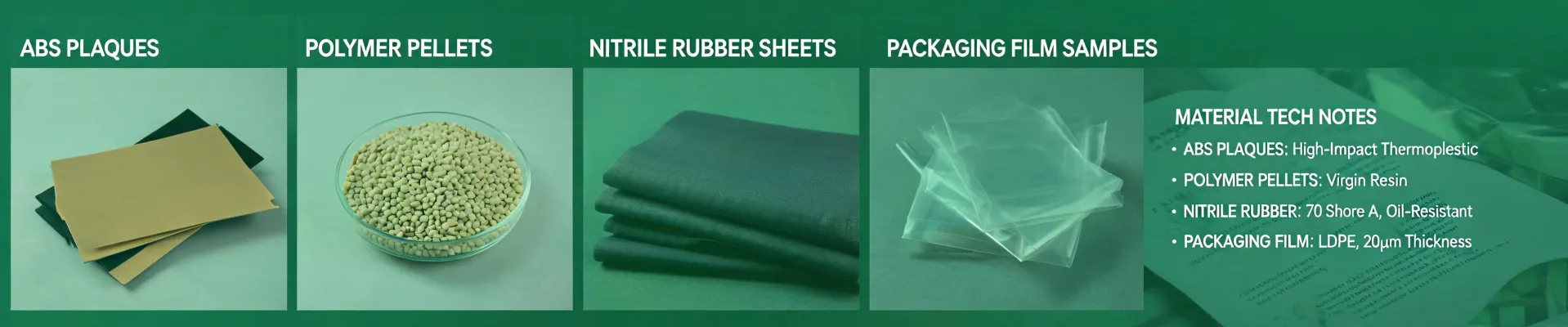
If you're sourcing ABS, PE, PP, or acrylic resins for your production line, you've probably seen a dozen supplier pitches this month. Every vendor claims good specs, competitive pricing, and reliable delivery. The question is: how do you separate the ones that actually deliver from the ones that just talk a good game?
I'm a quality compliance manager at a plastic products company. I review every incoming resin batch before it hits our factory floor—roughly 200+ unique deliveries annually. Based on what I've seen in 2024 and early 2025 (including a few expensive mistakes), here's a 4-step checklist for vetting suppliers. It's not exhaustive, but it covers the blind spots I keep seeing buyers miss.
Who This Checklist Is For
This is for procurement managers, production planners, and engineers who buy ABS, polycarbonate blends, nitrile rubber, or specialty polyolefins in bulk (think truckloads or ISO tanks). If you're tired of finding out about specification gaps after payment, or discovering hidden costs when the invoice arrives—this is for you.
Four steps. Let's go.
Step 1: Verify the Specs (Before You Talk Price)
I cannot stress this enough. Specs first. Everything else second.
What to ask for:
- Data sheets (physical, mechanical, thermal) for the exact grade you're buying, not a 'similar' product.
- Certificates of analysis (CoA) from the last 3 production lots.
- ISO or ASTM test methods used (e.g., ASTM D638 for tensile strength, ISO 178 for flexural modulus).
The surface illusion: People assume the lowest quote means the vendor is more efficient. The reality is that lower-priced resin often comes with wider tolerances—or a different melt flow index altogether. In Q1 2024, we rejected a batch of ABS because the impact strength was 15% below our spec. The vendor claimed it was 'within industry standard.' We saw the data, said no, and they re-did it at their cost.
Checkpoint: If the supplier hesitates to share batch-level CoAs before purchase, that's a red flag.
Step 2: Assess Supply Capacity and Sustainability Story
You're not just buying resin. You're buying a relationship that needs to survive production spikes, logistics hiccups, and increasingly, regulatory audits.
Ask three things:
- Production capacity: Can they scale with you? If your demand doubles in 2026, will they have the capacity, or will you be stuck with a supply gap?
- Sustainability documentation: Look beyond the marketing page. Ask for their latest sustainability report (e.g., INEOS published their 2024 report covering GHG emissions, circular economy initiatives, and bio-attributed products). If they can't produce a report with verifiable data, treat their 'green' claims as marketing fluff until proven otherwise.
- Supply chain redundancy: Do they have multiple production sites? One supplier we evaluated had a single plant for a critical acrylic resin. A flood in 2023 shut them down for 6 weeks. We only found out because we asked.
Everything I'd read about supplier selection said to trust the big names' stability. In practice, I've found that even major polymer producers can have single-point-of-failure risks. Ask the question.
Step 3: Ask About Pricing Models and Hidden Costs
This is where the 'transparency builds trust' principle kicks in.
What the quote should include:
- Base resin price per metric ton (ex-works or delivered).
- Logistics/freight costs (regional surcharges? fuel adjustments?)
- Minimum order quantity (MOQ) and whether partial truckloads trigger a fee.
- Payment terms and early payment discounts.
- Return/credit policy for off-spec material.
The trigger event: The pricing failure in September 2023 changed how I think about vendor questions. A supplier quoted us a competitive price for ABS, but the final invoice included a $1,800 'special handling' fee for smaller lot sizes—never mentioned upfront. I now send a checklist of 8 cost categories before accepting any quote.
In my opinion, the vendor who lists all fees upfront—even if the total looks higher—usually costs less in the end. Truthful pricing builds operational trust.
Step 4: Validate Quality Assurance and Consistency
This is my favorite step, because it's where most suppliers slip up.
Request their incoming QC protocol: Do they test every production lot, or just random samples? What happens if a batch fails in-process testing? (Hint: ask for a root cause analysis from a past incident—if they can't produce one, they probably don't track it.)
Check for consistency: Run a blind test. Request samples from 3 different production batches (if available) and test them against your critical parameters. Difference between specimens is often more telling than the absolute values.
Personal anecdote: I ran a blind test with our production team: same ABS grade from Supplier A vs Supplier B. 85% of operators identified Supplier A's material as 'more consistent' without knowing the source. The cost difference? $120 per metric ton. On a 50-ton monthly order, that's $6,000/month for measurably better process stability. Worth it.
Common Mistakes I See (and Made)
- Ignoring the 'soft' factors: Technical support availability matters. When our line had a processing issue with a new PP grade, having a responsive technical team (like INEOS's application engineers) meant the difference between a 2-day fix and a 2-week shutdown.
- Focusing only on price: The cheapest resin is never the cheapest when it causes line downtime or product returns.
- Skipping the sustainability audit: Regulators (and increasingly, your customers) will ask for Scope 3 emissions data. If your supplier has no data, you're stuck guessing.
Bottom line: A thorough vetting process—specs, capacity, pricing transparency, and QC validation—doesn't eliminate risk, but it reduces the unpleasant surprises. Take this checklist to your next supplier meeting. Ask the uncomfortable questions. The vendors who answer clearly and provide documentation are worth the investment.
Prices and regulatory details as of January 2025; verify current conditions with your supplier.
Ask About This Topic