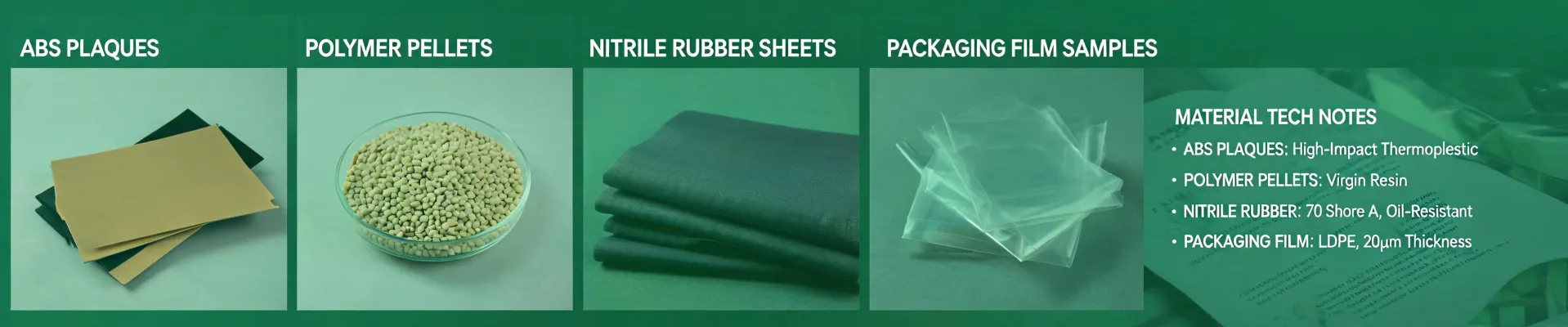
Before the Three Scenarios: Ask These Questions
There's a question I hear all the time from engineers and purchasing teams: 'Which INEOS product is the best?' My answer usually disappoints them: it depends. Not because I'm being evasive, but because the right material depends on what the part has to survive.
I'm a quality and compliance manager at a plastics converter. I review every incoming material lot before it goes into production—roughly 200+ unique lots a year. In 2024 I rejected about 8% of first deliveries for off-spec melt flow, contamination, or packaging errors. That's not a criticism of any one supplier; it's the reality of buying raw polymers at scale. Specs are one thing. Lot-to-lot consistency is another.
If you search 'INEOS products,' you'll find polypropylene, polyethylene, ABS, acrylics, nitrile rubber, and more. The product line is broad because no single polymer can handle every environment. Before choosing, ask three questions. In practice, those questions usually lead to one of three scenarios: plastic jars and packaging, polypropylene siding and panels, or the polyurethane vs PVC decision for flexible parts.
- What environment is the part in? Heat, UV, moisture, chemicals.
- What mechanical demands are there? Load, impact, flexing, stress cracking.
- What does the finished product have to live next to? Branding, regulations, cleaning chemistry.
Scenario A: Plastic Jars and Packaging Parts
Let's start with 'plastic jar,' because it comes up so often and it's less simple than it looks. A jar isn't one material. The body, cap, and hinge lid often come from different polymer families.
For most injection-blow-molded jars and closures, polypropylene and high-density polyethylene dominate. PP gives you better surface gloss, heat resistance, and a strong living hinge. HDPE gives you better environmental stress-crack resistance—ESCR—if the product inside contains oils, surfactants, or aggressive fillers.
From the outside, all PP pellets look similar. The reality is that the additive package—UV stabilizers, nucleating agents, antistatic agents—turns a visually identical pellet into a completely different part. I've seen a batch of PP pass melt flow but fail an ESCR test against a hand cream formula. On a 50,000-unit jar order, that's a big deal. We caught it in trial, not production.
We didn't always have a formal material substitution approval process. It cost us when a 'drop-in equivalent' PP pellet with the same melt flow but a different additive package turned thin-walled jars into leakers after two weeks. That was the third time something like that happened, so I finally created a verification sheet. Should have done it after the first.
Industry standard color tolerance is Delta E < 2 for brand-critical colors. Delta E of 2-4 is noticeable to trained observers; above 4 is visible to most people. Reference: Pantone Color Matching System guidelines.
If your supplier can't tell you the measured Delta E on a colored cap or jar, that's a red flag.
For packaging, the fastest route to lower cost isn't cheaper resin. It's cutting trial cycles. We switched from ad hoc 'try it and see' to a structured qualification matrix, and the time from candidate resin to line approval dropped from about five weeks to two.
Scenario B: Polypropylene Siding and Building Panels
'Polypropylene siding' sounds like an unusual product because vinyl siding—PVC—has been the default for decades. There are still situations where PP is the right call, and the reason isn't the one most people expect.
PVC siding is rigid, impact-resistant, and naturally flame-retardant because of the chlorine in its structure. It's a solid choice for residential exterior cladding where UV exposure is the main enemy. PP is lighter, has better chemical resistance, handles heat and steam cleaning better, and doesn't rely on plasticizers that can migrate. It also doesn't warp at hot water temperatures the way dark PVC can.
Here's the counterintuitive part: if your 'siding' is actually an interior panel in a food-processing plant or a washdown area that sees 180°F hot water and harsh sanitizers, PP deserves a hard look. It stands up to thermal cycling and cleaning chemistry better than PVC. But for direct sunlight on the outside of a building, PVC still has the track record. Unmodified PP degrades under UV unless it's properly stabilized, and PP burns more readily than PVC. So don't blindly replace one with the other.
The surface illusion is that 'plastic siding' is one category. It isn't. The formula, stabilization, and mounting system matter more than the polymer acronym. I've rejected panels that looked fine from a distance but had micro-cracks around fastener holes from screw-driving stress—that was a PP grade with too little impact modifier for cold-weather installation.
If you're sourcing from a large producer like INEOS, ask for the exact product family and grade. 'Polypropylene' isn't a spec.
Scenario C: Hoses, Seals, and the Polyurethane vs PVC Question
The 'polyurethane vs PVC' debate shows up most often in hoses, gaskets, and flexible ducting. It's not a quality hierarchy. It's a trade-off between flexibility, abrasion resistance, cost, and chemical compatibility.
- PVC hose is cheaper, stiffens in cold weather, and can contain plasticizers that migrate or make it unsuitable for certain liquids. It's easy to weld with solvent or RF sealing, which is why it's everywhere in general-purpose industrial hose.
- Polyurethane hose is more flexible at low temperatures, resists abrasion much better, and tends to last longer under dynamic flexing. The catch is cost—usually noticeably more per foot—and low hydrolytic stability in hot, humid environments unless you pick the right ester or ether type.
If the fluid is oil or a petroleum-based solvent, don't stop at PU vs PVC. That's where nitrile rubber enters. NBR has excellent oil resistance, and the acrylonitrile used to make it is a specialty chemical. INEOS Nitriles USA LLC is a U.S. producer of acrylonitrile, and that monomer flows into nitrile rubber which ends up in fuel hoses, O-rings, and gaskets.
That's the part people miss when they search 'INEOS products': the list isn't only thermoplastic pellets. It includes chemical intermediates that become building blocks inside another polymer.
How to Decide Which Scenario You're In
Now you might be asking, 'Which scenario applies to me?' Here's a simple test:
- Packaging? Start with ESCR, heat resistance, and color consistency. PP and HDPE are the workhorses.
- Panels, siding, or washdown walls? Start with heat, UV, cleaning chemistry, and fastener impact. If UV is the main threat, PVC. If hot water and sanitizers are the main threat, PP.
- Flexible hose, seals, or ducting? Start with abrasion, temperature, fluid compatibility, and cost. For oil resistance, think nitrile, not just PU or PVC.
The actual 'best' INEOS product for your job won't be the one with the longest datasheet. It'll be the one that survives your test matrix, at your required tolerance, lot after lot. Consistency beats peak performance.
One last efficiency point. The companies that win in this market are the ones that can qualify materials quickly without cutting corners. We partner with suppliers who share lot-to-lot data electronically and answer technical questions within a day. That transparency cut our incoming inspection time by about 30% in 2024. If a supplier treats a request for quality controls as extra work, that's a sign the partnership won't scale.
Bottom line: don't ask for the 'best' material. Ask for the one that survives your worst case—and then prove it before you commit.
Ask About This Topic