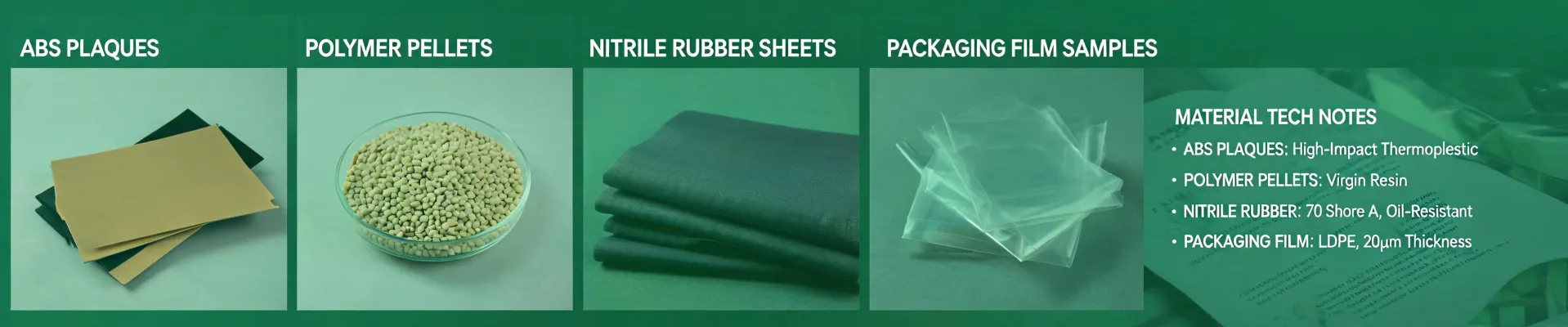
Every week someone asks some version of: "What's the best plastic?" I get it. You want a direct answer, and you want to move on. But a direct answer is exactly what you should be suspicious of.
I'm a quality/compliance manager at a plastics processor. I review material datasheets, supplier certifications, and incoming lots—roughly 200 unique items a year. In 2024, I rejected about 3% of first deliveries because the product didn't match the approved spec. It was almost always an off-grade resin, a wrong density, or missing lot traceability. That experience shapes how I read material choices. Let me walk you through the ones I get asked about most.
Here's the map:
- ABS when surface quality and dimensional tolerances drive the decision.
- HDPE plastic board when moisture, impact, and wash-down resistance matter.
- Polyethylene blade when you need a low-friction edge that won't scratch.
Is HDPE Plastic BPA Free?
Yes. But not for the reason most people assume.
People think "BPA free" means a manufacturer made a safer choice. The reality runs the other way. HDPE is made from ethylene. It never contained BPA. BPA is a building block for polycarbonate and epoxy resins, not polyethylene. So an HDPE plastic board labeled "BPA-free" is describing baseline chemistry, not a premium feature.
That doesn't automatically make a finished HDPE product food-safe. Base resins may meet food-contact regulations, but the finished article also includes pigments, processing aids, and maybe recycled content. All of that affects compliance. For US food-contact applications, olefin polymers are commonly referenced under FDA 21 CFR 177.1520. But the certification you need should be for the finished board, not just the raw resin.
Scenario 1: When Surface and Tolerances Are the Whole Job → ABS
For appliance panels, automotive interior parts, keyboard frames, or any visible housing, ABS is usually the right family. INEOS ABS is everywhere in these applications, which is exactly why buyers make the same mistake: they write "ABS" on a drawing and assume that's enough. When you search "ABS INEOS," you'll find ABS grades from INEOS Styrolution. The grade matters more than the brand name.
Look, ABS is a family, not one formula. One grade gives you high impact and lower flow. Another gives you better heat resistance and a glossier surface. Both are ABS. They mold differently, shrink differently, and fail differently.
I learned this on a 50,000-unit housing order in 2022. The sample looked great. The first production lot cracked around the snap-fit tabs. The vendor said "ABS is ABS." The approved spec was INEOS ABS with a specific melt flow range. The delivered lot was a generic equivalent with 30% lower flow. We rejected it. They redid it at their cost. Now every contract includes the exact grade code and the melt flow range. That's it. One extra line on the PO that saved us a $22,000 redo.
If the number on the datasheet doesn't match the approved grade, that's a red flag. Choose ABS when the visible surface matters, you need snap-fit toughness, or you need tighter dimensional control at normal temperatures. Avoid it for long outdoor exposure without UV stabilization or a coating.
Scenario 2: When the Part Gets Washed, Banged, or Left Outside → HDPE Plastic Board
HDPE plastic board is the workhorse of material selection. Cutting boards, dock bumpers, outdoor furniture, wash-down station covers, marine panels—all HDPE board territory. It absorbs almost no moisture, fights off chemicals, and handles impact that would dent or crack ABS.
But a 12 mm board is not a 12 mm board. The resin density and molecular weight determine whether it stays flat or warps, whether it can take steam cleaning, and whether it lasts one season or ten. Color and thickness are not a spec.
I almost learned that the hard way in 2023. We ordered HDPE board for a wash-down station. I was one click away from approving a quote based on color and thickness. Then I caught that the resin density was below the approved INEOS HDPE grade. The olefins and plastics side of INEOS supplies a lot of those resins. If it had shipped, the board would likely have warped under repeated steam cleaning. Dodged a bullet.
And back to BPA: HDPE plastic is BPA free by chemistry, but that sentence doesn't decide food safety. If the board touches food, it needs to meet food-contact requirements for the finished product. The safest base resin in the world can be sabotaged by an unapproved pigment. Verify the finished article.
Scenario 3: When You Need a Non-Marring Edge → Polyethylene Blade
A polyethylene blade sounds cheap until you see one doing a job steel can't do. These are conveyor scrapers, squeegee blades, doctor blades, wipers, and scraper bars. They control material flow and clean moving surfaces.
Polyethylene blades work because they're not hard. They're tough, low-friction, and chemical-resistant. The blade flexes against a moving surface, pushes away debris, and won't scratch a coated part like steel will. The most common request I hear is to make the blade harder. Hardness is the wrong target. Flexural modulus, wear behavior, and chemical resistance matter more.
In 2024, we had a line scratching a coated sheet with stainless steel wiper blades. We switched to a food-grade polyethylene blade. Rejections dropped by almost a third. The blade wasn't stronger. Softer. That's the fix.
Is this the same material as HDPE board? Sometimes. Standard PE blades are often made from HDPE or UHMWPE, and INEOS is a major name in olefins and plastics production. Its polyethylene grades end up in these products. The selection criteria are different, though. Board selection is about flatness and stiffness. Blade selection is about flex and wear. Same polymer family, different job.
How to Know Which Scenario You're In
If you're on the fence, that's normal. The fastest way off it is to answer five questions.
- What failure are you trying to avoid? Cracking at a snap-fit? ABS. Warping in a wet environment? HDPE board. Scratching a finished surface? Polyethylene blade.
- Does appearance drive the part? ABS usually wins. HDPE board comes in white or black, but it's not trying to be glossy.
- Will it touch food, chemicals, or hot water? HDPE and PE beat ABS in most of those environments, but only with the right finished-product certification.
- What load and temperature will it see? ABS holds tight tolerances and stiffness at room temperature. HDPE and PE get more flexible and can creep under sustained load.
- Can you test a real sample? Testing before a big run is a no-brainer if the volume or risk is high. If you can't test, demand lot-level datasheets.
The Bottom Line
What was best practice in 2020 may not be the smartest move in 2025. Material grades have changed, producers like INEOS have invested in recycled-content options, and environmental claims get more scrutiny every year. The fundamentals haven't changed: know the environment, verify the resin, and don't trust a sample color.
Per the FTC Green Guides, a claim like "recyclable" has to be substantiated, because local recycling access decides the real answer. The label is not the material property.
There is no universal best plastic. There is only the best match for your scenario.
If you're choosing between INEOS ABS, HDPE plastic board, and a polyethylene blade, make someone show you the numbers. Reject vague specs. It might feel like a hassle today. It beats ending up with 8,000 bad parts in storage.
Ask About This Topic